Cloud Migration Challenges: Why So Many Projects Go Over Budget
Cloud migration is marketed as inevitable.
Move to the cloud.
Cut infrastructure costs.
Improve scalability.
Future-proof the business.
And yes — cloud infrastructure can absolutely deliver those outcomes.
But here’s the uncomfortable truth:
Cloud migration amplifies whatever discipline (or lack of it) already exists inside your organisation.
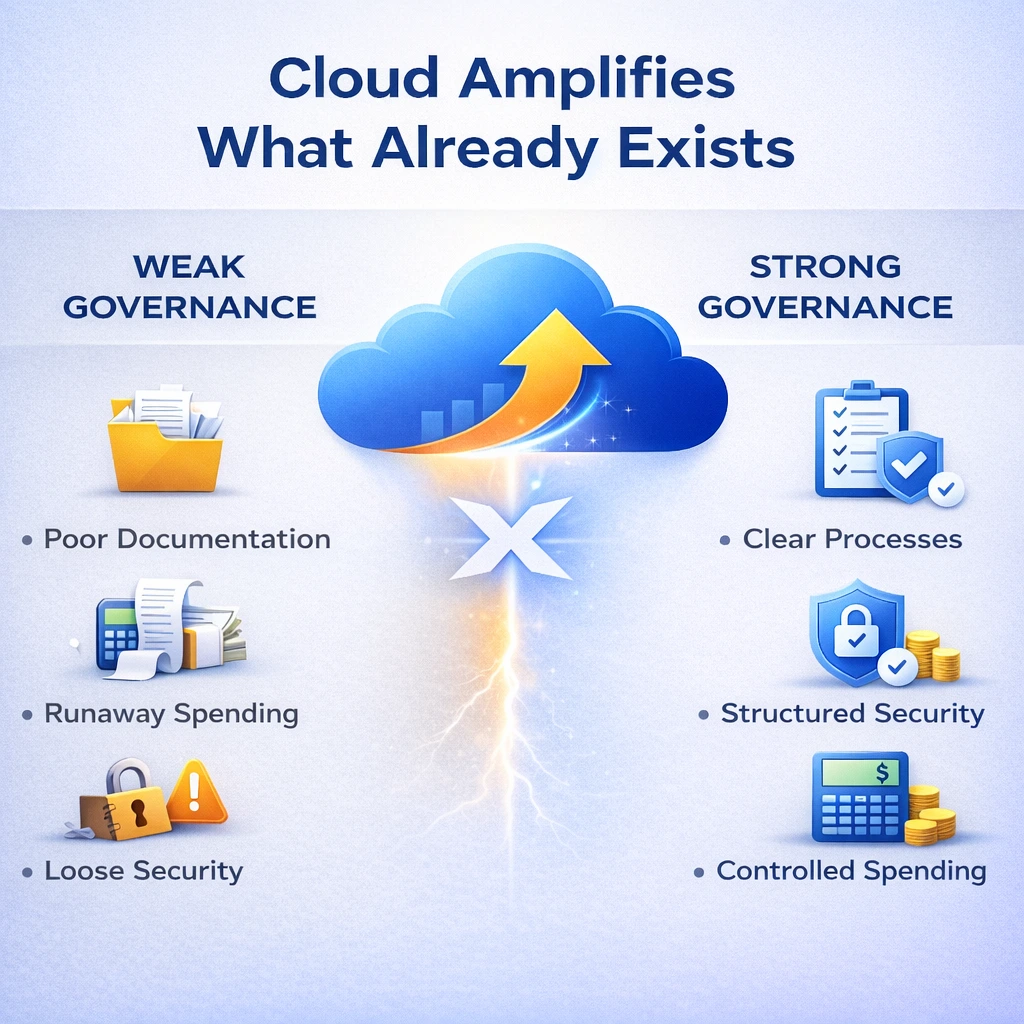
Poor documentation becomes chaos.
Weak governance becomes runaway spending.
Loose security becomes exposure at scale.
Before diving deeper into the challenges, it’s worth revisiting what cloud migration actually involves. If you need a foundational breakdown, see this detailed guide on what cloud migration is.
Migration is not a data transfer.
It is a structural redesign of how your business runs technology.
What Is Cloud Migration?
Cloud migration is the process of moving applications, data, workloads, and infrastructure from on-premise environments into cloud platforms — public, private, or hybrid.
It may involve:
Rehosting (“lift and shift”)
Replatforming applications
Refactoring legacy systems
Rebuilding infrastructure entirely
The method you choose determines cost, risk, and long-term performance.
Businesses engaging structured providers like Code Hyper typically treat migration as part of broader IT strategy rather than an isolated technical event. That integration — especially around security and disaster recovery — is what prevents disruption.
Benefits of Cloud Migration (When Done Correctly)
Cloud migration offers substantial advantages. But those benefits are conditional on execution.
Scalability is the obvious gain. Infrastructure expands or contracts based on demand. You are no longer limited by server rack capacity.
Operational agility improves dramatically. Provisioning environments takes minutes instead of weeks. Innovation accelerates.
Cost structure shifts from capital expenditure to operational expenditure, improving cash flow predictability.
Resilience improves when paired with proper disaster recovery planning. Integrating migration with a structured cloud migration service framework ensures continuity planning is built in — not added later as an afterthought.
Collaboration improves as well. Cloud infrastructure integrates seamlessly with platforms like Microsoft 365, supporting hybrid and remote work models.
For a deeper analysis of long-term upside, this related article expands on strategic cloud migration benefits.
But benefits without governance turn into liabilities.
The Real Cloud Migration Challenges
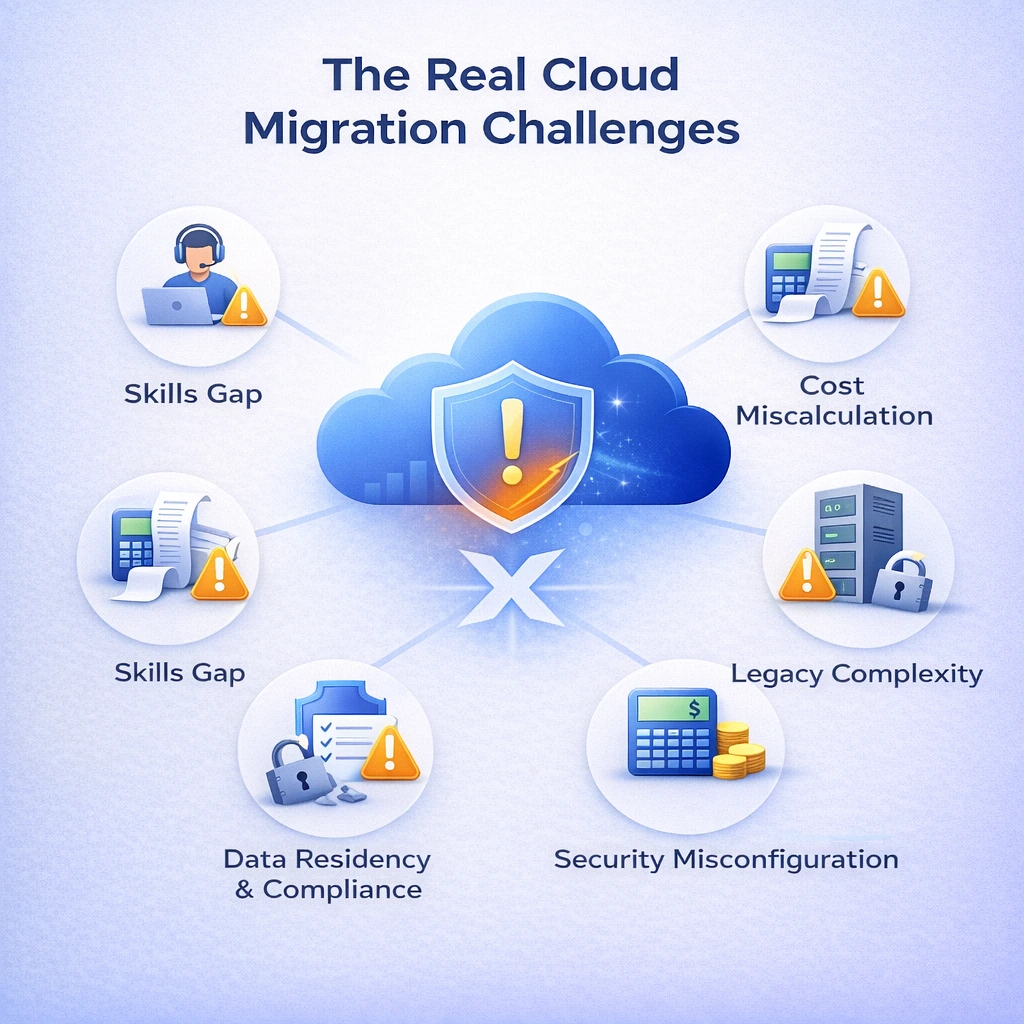
Now we address the core issue directly.
1. Cost Miscalculation
Cloud providers make infrastructure look simple. Pricing models are not.
Hidden cost drivers include:
Data egress fees
Overprovisioned compute resources
Storage tier mistakes
Licensing changes
Security tooling
Backup and retention requirements
Without financial governance (often referred to as FinOps), cloud spending can exceed previous on-premise budgets within months.
2. Legacy System Complexity
Older applications were not designed for elastic infrastructure. Some require rewriting. Others require partial redesign.
A lift-and-shift approach often moves inefficiency into a more expensive billing model.
3. Security Misconfiguration
Cloud security operates under a shared responsibility model. Providers secure infrastructure. Customers secure configurations.
Misconfigured permissions are one of the leading causes of cloud breaches, as documented by industry frameworks like the (NIST Cybersecurity Framework).
Before migrating, organisations should assess posture through structured reviews such as Code Hyper cloud-security-assessment.
4. Data Residency & Compliance
Australian businesses handling regulated data must evaluate storage region, access controls, and compliance obligations.
This becomes especially relevant when reviewing government-backed security guidance such as the Essential Eight framework.
5. Skills Gap
Many internal IT teams are experienced in on-premise infrastructure but lack cloud architecture optimisation expertise.
This leads to:
Overprovisioning
Poor access control models
Inefficient workload allocation
Performance bottlenecks
Cloud amplifies skill gaps quickly.
Cloud Migration Costs: A Comprehensive View
Most businesses calculate migration cost incorrectly.
They focus on server replacement savings.
They ignore:
Planning and architecture design
Data migration labour
Application refactoring
Security integration
Backup rebuild
Monitoring systems
Ongoing optimisation
For example. A business migrating to Microsoft 365 may assume backup is included. It isn’t. Dedicated backup solutions are required, as explained in this breakdown of m365-backup-solutions.
Cloud environments are powerful — but not self-maintaining.
How to Calculate the Real Cost of Cloud Migration
Accurate modelling requires discipline.
Start with total cost of ownership (TCO) for your current environment, including:
Hardware depreciation
Maintenance contracts
Energy costs
Downtime incidents
Staff allocation
Physical space
Then model projected cloud resource usage conservatively.
Add security tooling. Add backup. Add monitoring. Add compliance tools.
Finally, include contingency buffers of 15–25%.
Cloud ROI often appears in operational efficiency and reduced downtime — not immediate invoice reductions.
How to Avoid Runaway Cloud Migration Costs
Here is where bullet points are useful — but only briefly.
To prevent uncontrolled spending:
Implement cost monitoring before full deployment
Assign cost ownership to departments
Decommission unused instances immediately
Schedule quarterly optimisation reviews
Use automated scaling instead of fixed provisioning
Cloud is financially efficient only when actively governed.
Five Phases of Successful Cloud Migration
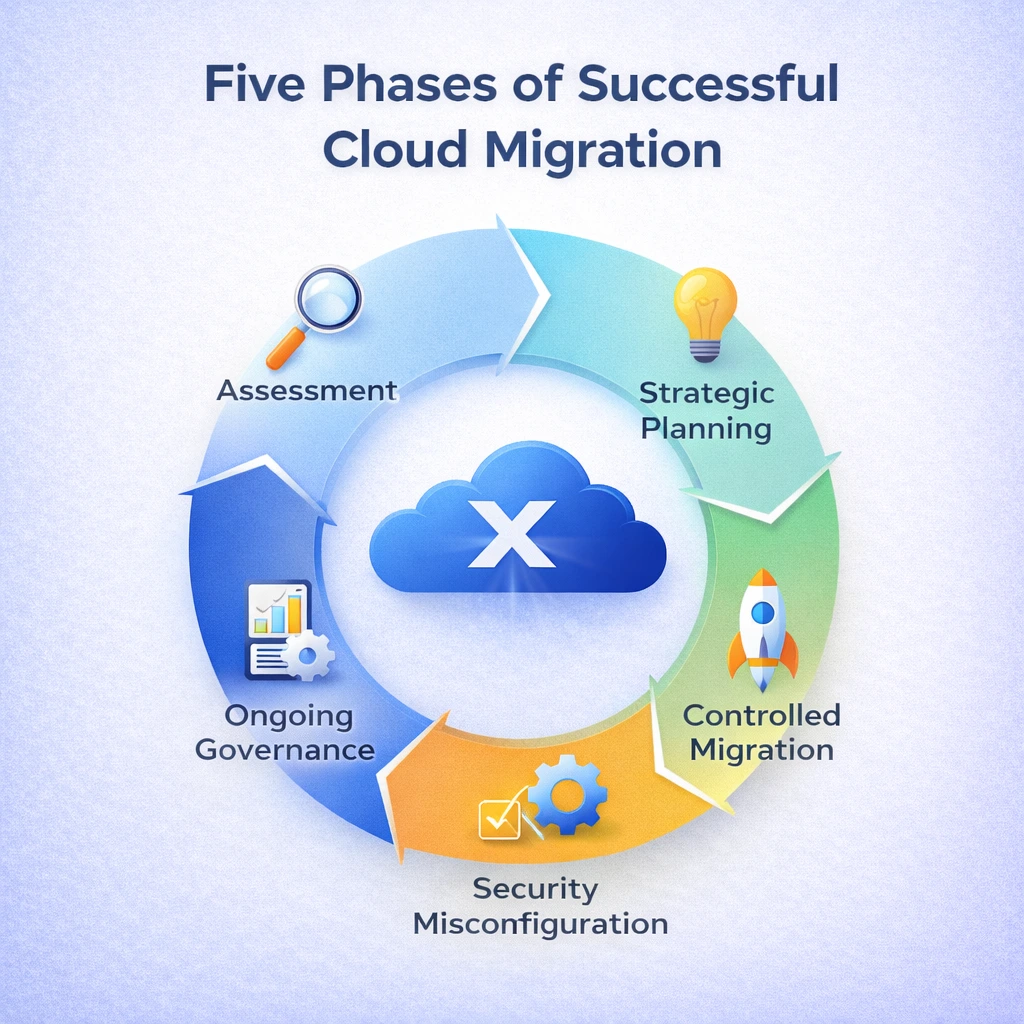
Structured migration typically follows five phases:
Assessment
Strategic Planning
Controlled Migration
Optimisation
Ongoing Governance
Skipping assessment creates architectural flaws.
Skipping governance creates financial instability.
Migration is not complete at go-live.
It stabilises only after optimisation.
Case Study: On-Prem to Cloud Transformation (Sydney-Based Firm)
A Sydney-based organisation running aging on-premise servers faced escalating hardware refresh costs and downtime risk.
Instead of performing a rushed migration, they implemented a structured on-prem to cloud transition similar to the approach outlined in this documented project.
The strategy included:
Phased workload migration
Identity restructuring
Security posture reassessment
Backup redesign
Disaster recovery planning
Security was strengthened during migration — not after.
The outcome:
Reduced infrastructure management overhead
Faster provisioning of business systems
Improved uptime stability
Predictable operational budgeting
The key lesson: cloud success was governance-driven, not tool-driven.
Why Cloud Migration Remains a Hurdle for Some Enterprises
Cloud exposes organisational inefficiencies.
If documentation is weak, migration stalls.
If governance is unclear, costs spike.
If leadership sees cloud purely as a cost-cutting tool, disappointment follows.
Enterprises that struggle usually approach migration as a technical task.
Enterprises that succeed treat it as strategic transformation supported by structured IT consulting frameworks.
Cloud rewards alignment between finance, operations, and IT.
How Does Cloud Migration Help Reduce IT Operational Costs?
When properly governed, cloud migration reduces operational friction by:
Eliminating hardware refresh cycles
Reducing physical maintenance
Automating scaling
Improving disaster resilience
Consolidating infrastructure management
But unmanaged cloud environments frequently exceed previous budgets.
Cloud cost savings are engineered.
They do not happen automatically.
What Are the Benefits and Challenges of Cloud Migration?
Benefits include scalability, agility, resilience, and collaboration enhancement.
Challenges include cost unpredictability, compliance complexity, skills shortages, and configuration risk.
The outcome depends less on the cloud platform and more on execution discipline.
Final Thoughts: Cloud Is an Accelerator — Not a Shortcut
Cloud migration is one of the most powerful infrastructure decisions a business can make in 2026.
But it is not a shortcut to efficiency.
It is an accelerator.
If your processes are strong, cloud amplifies growth.
If governance is weak, cloud amplifies chaos.
Australian organisations that combine migration with structured planning, security assessment, disaster recovery integration, and ongoing optimisation consistently outperform those chasing quick cost reductions.
The cloud does not eliminate complexity.
It demands maturity.
And businesses that embrace that reality turn migration challenges into long-term competitive advantage.