Every time someone visits your website, two invisible technologies go to work instantly: DNS and SSL.
Most business owners never think about them — until something breaks.
Misconfigured DNS can take your website offline. An expired SSL certificate can destroy trust overnight. And both directly impact your SEO rankings, security posture, and customer confidence.
In 2026, understanding DNS and SSL isn’t optional. It’s foundational.
What is DNS?
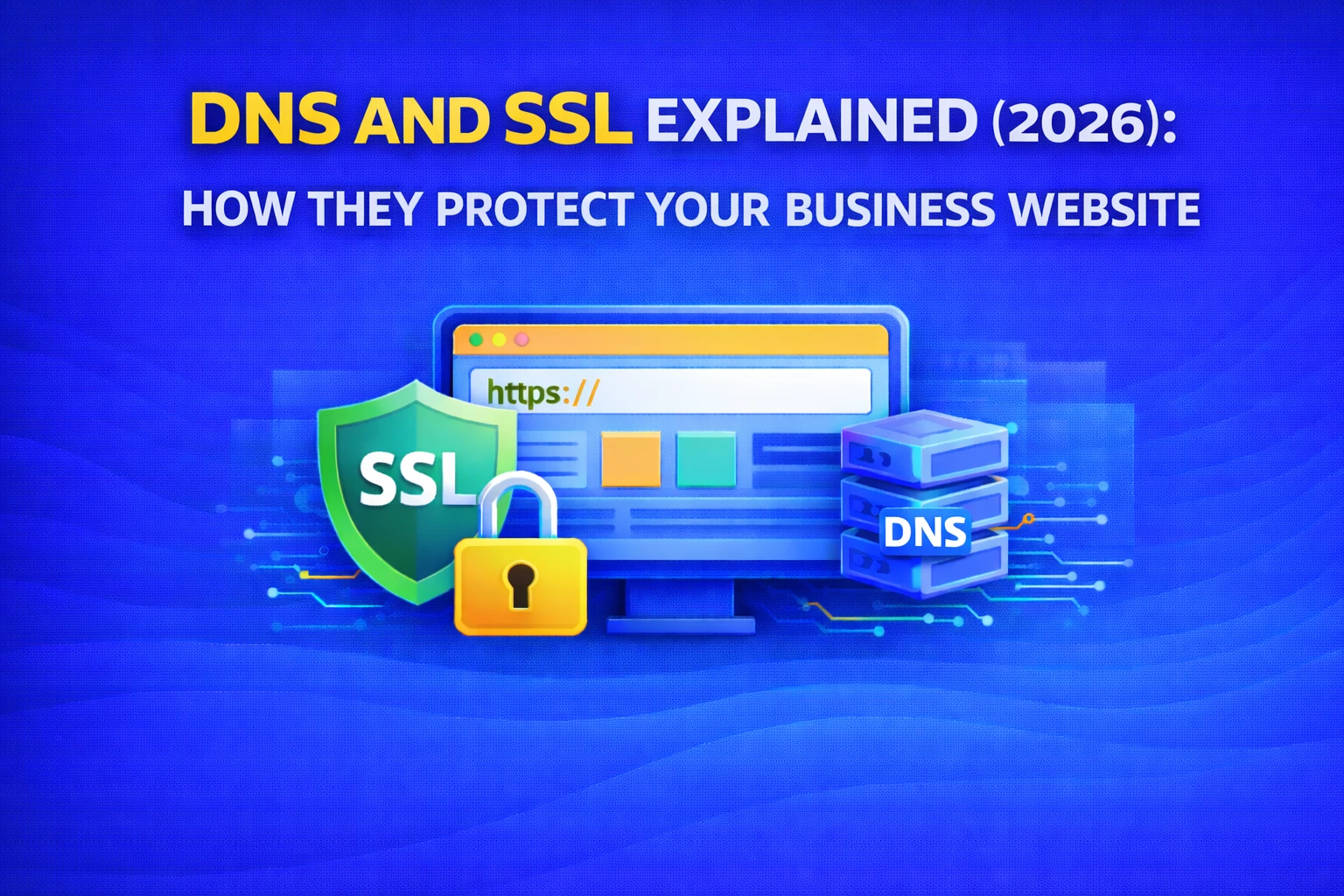
DNS (Domain Name System) is the system that translates your domain name into a server IP address.
When someone types your website URL into a browser, DNS tells the internet where your website actually lives.
Without DNS:
- Your website can’t be found
- Your email won’t deliver
- Your subdomains won’t resolve
- Your services become unreachable
Think of DNS as the internet’s phonebook.
But it’s not just about lookup — it’s about control and resilience.
What is SSL?
SSL (Secure Sockets Layer), now technically implemented via TLS, encrypts the data transferred between a user’s browser and your website.
That’s what creates the padlock icon in the browser.
Without SSL:
- Login credentials can be intercepted
- Customer data can be exposed
- Browsers display security warnings
- Google may downgrade rankings
Google has officially confirmed HTTPS as a ranking signal in its webmaster guidance, reinforcing why SSL is mandatory for modern websites.
Why DNS and SSL matter for SEO
DNS affects:
- Website uptime
- Speed of resolution
- Global accessibility
SSL affects:
- User trust
- Conversion rates
- Search engine visibility
A slow DNS provider increases time-to-first-byte (TTFB).
An expired SSL certificate can instantly reduce clicks because browsers show “Not Secure.”
If your homepage is your digital storefront, DNS and SSL are the foundation beneath it.
DNS vs SSL: What’s the difference?
Feature | DNS | SSL |
Purpose | Directs traffic to server | Encrypts traffic |
Security role | Indirect (routing integrity) | Direct (data encryption) |
SEO impact | Speed & uptime | Ranking & trust |
Visible to users | No | Yes (HTTPS & padlock) |
Risk if misconfigured | Website/email outage | Security warnings & data exposure |
Both are essential. One doesn’t replace the other.
Common DNS mistakes businesses make
- No redundancy (single DNS provider)
- Poor TTL configuration
- Missing SPF, DKIM, or DMARC records
- No DNS monitoring
- Slow global propagation
DNS is often ignored because “it works” — until it doesn’t.
Common SSL mistakes businesses make
- Letting certificates expire
- Using outdated TLS versions
- Improper certificate installation
- No auto-renewal
- Weak encryption configuration
SSL issues directly damage trust. Even a short certificate lapse can impact revenue.
How DNS and SSL fit into modern cyber security
DNS is increasingly targeted by attackers through:
- DNS hijacking
- Cache poisoning
- Domain spoofing
SSL protects against:
- Man-in-the-middle attacks
- Credential interception
- Data manipulation
According to guidance from the Australian Cyber Security Centre (ACSC), proper encryption and secure configuration are baseline requirements for protecting online services.
That means DNS and SSL are not just technical components — they are risk management tools.
Why businesses use managed DNS and SSL services
Managing DNS and SSL internally sounds simple — until:
- Records conflict
- Certificates fail to renew
- Downtime impacts revenue
- Email authentication breaks
- A cyber incident requires rapid DNS changes
This is why many organisations use structured management through dedicated infrastructure services.
Code Hyper provides managed DNS and SSL configuration and monitoring services designed to ensure uptime, encryption integrity, and compliance alignment.
When configured correctly, DNS and SSL become silent protectors instead of business risks.
Final Thoughts
DNS and SSL operate behind the scenes, but they directly affect uptime, trust, security, and SEO.
If your business depends on its website — and every business does — then DNS and SSL must be treated as infrastructure, not afterthoughts.
Configured correctly, they become invisible strengths.
Configured poorly, they become visible failures.
FAQs
What happens if my SSL certificate expires?
Browsers show a “Not Secure” warning. Many users will immediately leave your site.
Can DNS affect my email?
Yes. Incorrect MX, SPF, or DMARC records can stop email delivery or increase spoofing risk.
Does SSL improve SEO?
Yes. HTTPS is a confirmed ranking factor and increases user trust signals.
Is free SSL enough?
Sometimes. But business environments often require stronger encryption, wildcard certificates, or multi-domain setups.
Should DNS be hosted separately from web hosting?
Often yes. Independent DNS improves redundancy and security.