Quantum computing is no longer a distant sci-fi concept; it’s approaching a reality that could upend how we think about data security. For many small and mid-sized businesses (SMEs), today’s encryption standards may not be enough to protect sensitive data in the coming years. In this article, you’ll understand what post-quantum cybersecurity means, why it matters now, and exactly how to begin preparing, including a free readiness checklist to evaluate your current setup.
What Is Post-Quantum Cryptography (PQC)?

At its core, post-quantum cryptography refers to encryption and signature algorithms designed to remain secure even against quantum computers. Traditional cryptography relies on mathematical problems (like factoring large numbers) that classical computers struggle to solve, but powerful quantum machines could crack them easily. (NIST)
In practice, PQC algorithms employ different mathematical structures (such as lattice-based or hash-based algorithms) that remain intractable for both classical and quantum computers. These algorithms aim to cover two critical tasks:
- Encrypting data so it cannot be intercepted and decrypted. (NIST)
- Generating digital signatures/authentication that remain valid under quantum-era threats. (NIST)
Because quantum computing could one day break today’s encryption, PQC is about future-proofing data and communications.
Why SMEs Should Care, Even in 2026
Concern | What it means for SMEs |
“Harvest Now, Decrypt Later” | Cyber adversaries may already be collecting encrypted data; they could decrypt it once quantum computers mature. |
Long-term data value | Business records, contracts, IP, and customer info may remain sensitive for decades. |
Regulation & compliance trends | As governments/government-suppliers move toward quantum-safe standards, businesses may need to comply (especially in sectors like finance, health, and legal). |
Competitive advantage & trust | Early adoption shows security maturity, useful when bidding for contracts or reassuring clients. |
Even if quantum-proof systems aren’t mandatory yet, the “future-proof early” strategy makes sense for businesses that care about data longevity and compliance.
How Post-Quantum Security Fits Into Your Existing Cyber Program
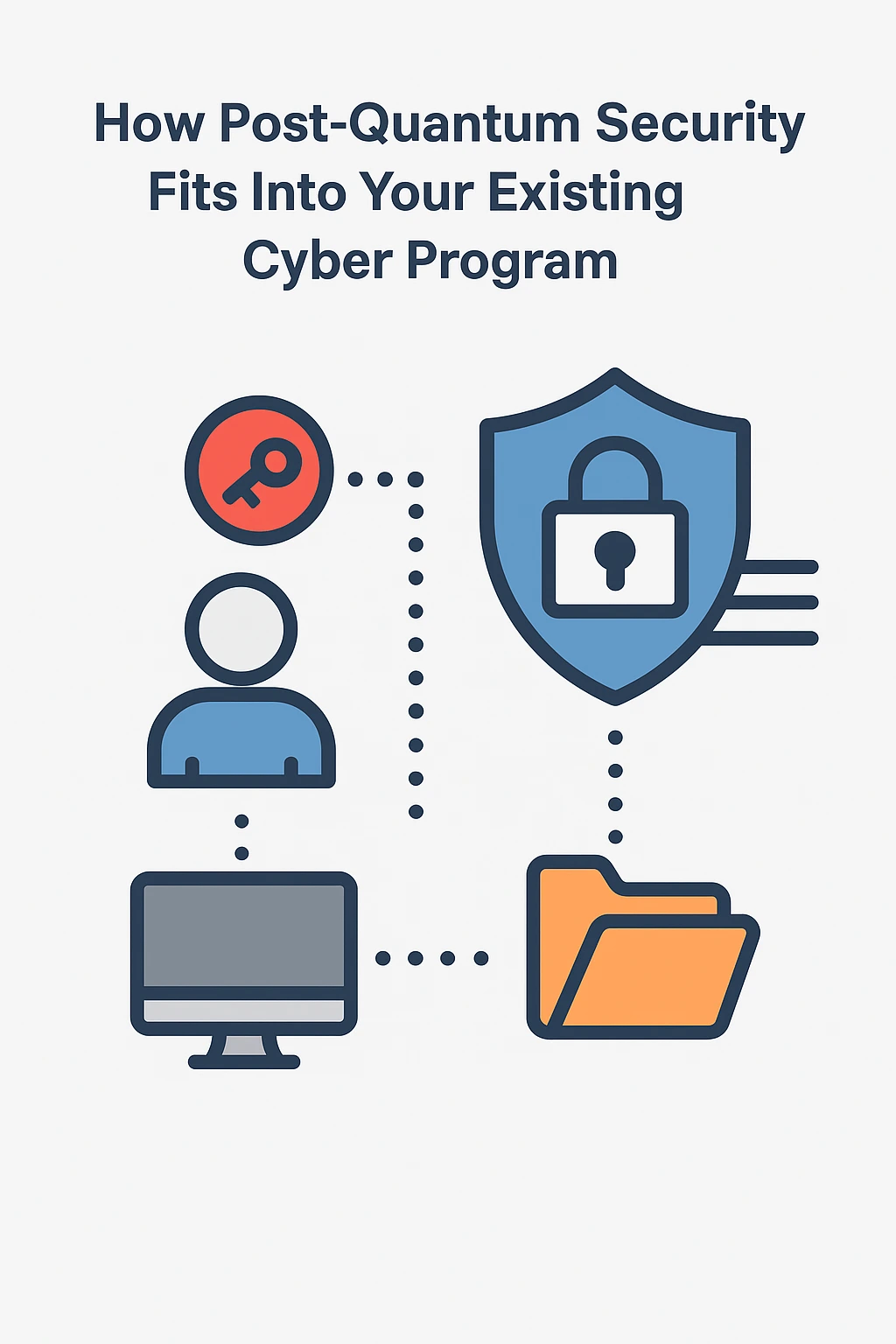
If your business already uses a baseline cybersecurity framework, say, hardened identity management, backups, EDR/endpoint protection or even aligns with frameworks like the Australian Cyber Security Centre (ACSC) Essential Eight, PQC isn’t a replacement. It’s a strategic layer added on top, aimed at long-term data resilience.
Key integrations:
- Keep Identity & Access hardening (MFA, least privilege, conditional access).
- Maintain backups and disaster-recovery preparedness.
- Keep network segmentation, patching, and endpoint protection using modern EDR solutions.
- Treat PQC as a crypto-agility roadmap, and plan a gradual migration for critical systems.
📄 Post-Quantum Readiness Checklist & Roadmap
Below is a simple readiness model you can use to assess where your business stands, and what to tackle first. Use as a guide to build your own transition plan.
✅ Step | What to do/check |
1. Inventory sensitive systems/data | List all services that rely on encryption, email, file storage, backups, VPNs, and authentication portals. |
2. Prioritise by data sensitivity & retention | Flag systems holding long-term data (customer info, financials, contracts, IP). |
3. Confirm vendor/software PQC support roadmap | Check if your software/cloud vendors have plans for quantum-safe encryption (or hybrid modes). |
4. Ensure crypto-agility & key management flexibility | Use key-management solutions that support algorithm updates without a full system overhaul. |
5. Plan phased migration (test → pilot → full) | First test PQC on non-critical systems; then pilot on sensitive but non-mission-critical; then full roll-out. |
6. Maintain fallback & compatibility strategies | Retain backwards-compatible encryption or hybrid modes while ecosystem transitions. |
7. Monitor industry & compliance updates | Stay updated on regulatory shifts, vendor PQC support, and standards (e.g. from NIST, ACSC). |
Downloadable asset
You can download a ready-to-use “Post-Quantum Readiness Checklist (Excel / Google Sheet)” to track these steps internally and assign owners & deadlines.
Challenges & Realistic Limitations
- Quantum-safe adoption is still early — not all software/cloud vendors support PQC yet.
- Performance & compatibility trade-offs — PQC algorithms may be more resource-intensive or less mature than classical ones.
- Cost vs urgency debate — for many SMEs, the risk may seem theoretical; investing now vs waiting depends on data sensitivity and retention timelines.
- Regulatory ambiguity — until quantum-safe encryption becomes a compliance requirement, the decision remains mostly strategic.
Despite these challenges, having a crypto-agility plan now is increasingly considered best practice for future-proof security.
What SMEs Should Do Right Now: 4-Step Action Plan
- Perform the readiness checklist above — inventory, prioritise, and map critical systems.
- Talk to your vendors / SaaS providers — ask about their PQC roadmap and support for hybrid quantum-safe encryption.
- Segment & isolate sensitive data/services — start migration on lower-risk assets first, iterate gradually.
- Monitor standards & regulations — track guidelines from bodies like ACSC or equivalent, and build PQC into your long-term security roadmap.
Implementing PQC is not a one-day job — but beginning the roadmap now is what separates reactive vs proactive cybersecurity postures.
Conclusion
Quantum computing poses a real and long-term threat to traditional encryption. For SMEs that care about data integrity, compliance, and business reputation, post-quantum cybersecurity shouldn’t be dismissed as a sci-fi future; it’s a strategic necessity. Starting early with a readiness plan, vendor dialogues, and phased migration gives you a head start and ensures that when “Q-day” arrives, you’re not scrambling; you’re prepared. Crypto-agility is no longer optional; it’s a forward-looking shield.
If you need ongoing support, a Managed Security Service can help monitor your systems, apply updates, and guide your transition to quantum-safe encryption.
Frequently Asked Questions
What exactly makes post-quantum cryptography different from standard encryption?
Post-quantum cryptography uses mathematical problems (like lattices or hash-based schemes) that are believed to be hard even for quantum computers, unlike RSA or elliptic-curve cryptography, which quantum machines could break. (NIST)
If quantum computers don’t exist yet, why should we act now?
Because threat actors can already be storing encrypted data today, once quantum computers arrive, they could decrypt years-old data. Taking steps now is about future-proofing, especially for sensitive long-lifetime data.
Is post-quantum encryption ready for enterprise use today?
Partially. Standards are maturing (e.g. via the National Institute of Standards and Technology, NIST), and some vendors are rolling out proof-of-concept PQC support. But widespread adoption across all software/ecosystems will take time; hybrid or phased migration is currently the most practical approach. (NIST)