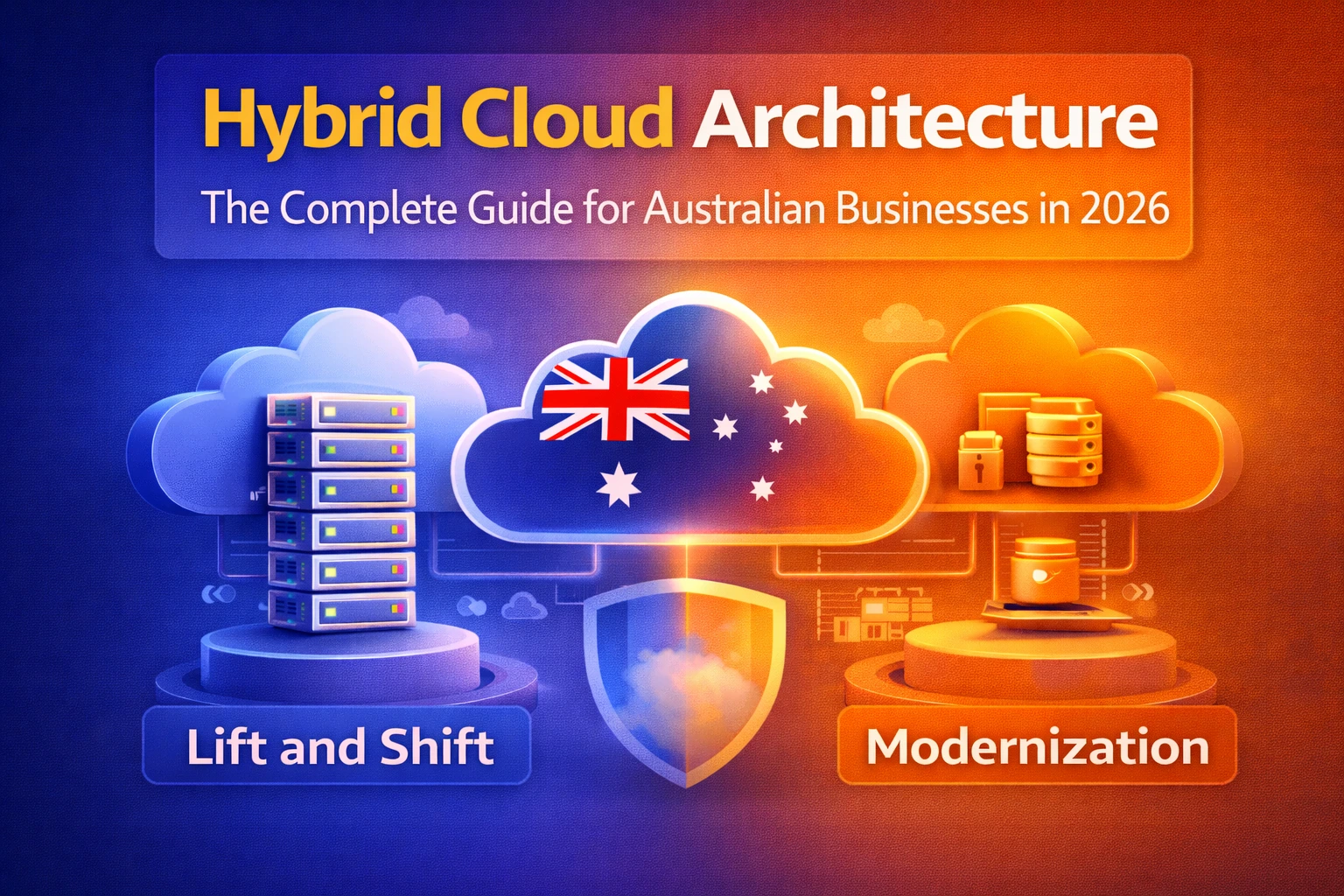
The debate between on-premises and cloud-only IT infrastructure is largely over — and neither side won outright. In 2026, the vast majority of Australian enterprises and SMBs operate in a hybrid cloud architecture: a carefully designed blend of private infrastructure, public cloud services, and on-premises systems that work together as one unified environment.
The appeal is simple. Hybrid cloud gives businesses the flexibility to place each workload exactly where it performs best — sensitive data on private infrastructure, scalable compute in the public cloud, and edge processing close to users. But hybrid cloud is only as good as the architecture behind it. Done poorly, it becomes expensive, complex, and hard to secure. Done well, it becomes the most powerful and resilient IT foundation a business can have.
This guide covers everything you need to know about hybrid cloud architecture — what it is, how it works, the core design patterns, the security implications, and how Australian businesses can implement it effectively. For a broader introduction to cloud adoption, start with our guide on what cloud migration involves, or explore our dedicated cloud migration services to see how we help businesses make the move.
What Is Hybrid Cloud Architecture?
Hybrid cloud architecture is the strategic integration of private cloud or on-premises infrastructure with one or more public cloud platforms — such as Microsoft Azure, AWS, or Google Cloud — into a single, coordinated environment. The defining characteristic is interoperability: workloads and data can move between environments while maintaining unified management, consistent security policies, and seamless connectivity.
It is not simply having some servers on-premises and some workloads in the cloud in separate silos. True hybrid cloud architecture requires deliberate design — networking bridges between environments, shared identity and access management, consistent governance policies, and integrated monitoring and observability across both private and public infrastructure.
Think of it this way: a public cloud alone gives you elasticity but limited control over sensitive data. An on-premises setup gives you full control but limited scalability and high capital expenditure. Hybrid cloud architecture gives you both — and that is precisely why it has become the dominant enterprise IT model heading into 2026.
Hybrid Cloud vs Multi-Cloud: What’s the Difference?
These terms are often used interchangeably but they refer to different approaches. Hybrid cloud specifically describes the integration of private and public cloud environments. Multi-cloud refers to using multiple public cloud providers — for example, running some workloads on AWS and others on Azure — without necessarily involving private infrastructure.
Many organisations operate both simultaneously: a hybrid multi-cloud environment that combines on-premises systems with two or more public cloud providers. This is increasingly common in regulated industries and large enterprises with diverse workload requirements.
Core Components of a Hybrid Cloud Architecture
Understanding hybrid cloud architecture requires understanding its building blocks. Each component plays a specific role in making private and public environments work together seamlessly.
1. Private Cloud or On-Premises Infrastructure
This is the foundation of the private side of your hybrid environment. It may include physical servers in your own data centre, a virtualised private cloud using platforms like VMware vSphere or Microsoft Hyper-V, or a hosted private cloud in a colocation facility. This environment is under your direct control — you manage compute, storage, networking, and security. It is where you run workloads that require low latency, data sovereignty, strict compliance, or direct hardware access. See our article on what the cloud is for a clear breakdown of private vs public cloud fundamentals.
2. Public Cloud Services
The public cloud side provides access to virtually unlimited compute, storage, managed databases, AI services, CDN capabilities, and global infrastructure — all on a pay-as-you-go model. Microsoft Azure, AWS, and Google Cloud are the dominant providers in Australia. These platforms give you the elastic scalability that on-premises environments simply cannot match, making them ideal for variable workloads, development environments, and customer-facing applications.
3. Hybrid Connectivity Layer
Connectivity is the backbone of any hybrid cloud architecture. Without reliable, secure, low-latency links between your private and public environments, hybrid cloud is just two separate IT systems. Common connectivity options include:
- Site-to-Site VPN: Encrypted tunnels over the internet — cost-effective for lower-bandwidth needs and simpler environments
- Azure ExpressRoute / AWS Direct Connect: Dedicated private network connections to cloud providers, bypassing the public internet entirely — essential for high-throughput, latency-sensitive workloads
- SD-WAN: Software-defined wide area networking that intelligently routes traffic across multiple links based on performance and cost
4. Unified Management and Orchestration
Managing two separate environments without a unified control plane creates operational chaos. Modern hybrid cloud architectures use tools like Microsoft Azure Arc, AWS Outposts, or VMware Cloud Foundation to provide a single pane of glass for deploying, monitoring, and governing workloads across both private and public environments. Infrastructure-as-Code (IaC) tools like Terraform and Ansible ensure consistent, repeatable deployments regardless of where resources are provisioned.
5. Identity and Access Management (IAM)
Consistent identity is critical. In a hybrid environment, users, applications, and services need to authenticate and authorise across both private and public infrastructure using a single identity framework. Microsoft Entra ID (formerly Azure Active Directory) is the most widely used solution for Australian businesses, providing single sign-on, multi-factor authentication, and conditional access policies that span both on-premises Active Directory and cloud services. For more detail on how Entra ID protects hybrid environments, see our Entra ID Protection guide.
6. Security and Compliance Controls
Hybrid cloud architecture expands the attack surface significantly — every connection point between private and public environments is a potential vulnerability. A robust hybrid security posture requires unified security policies enforced across both environments, zero-trust network access, encryption in transit and at rest, and centralised logging and monitoring. Our cloud security assessment service helps businesses identify and close the security gaps that hybrid architectures commonly introduce.
7. Data Management and Portability
Data is often the most complex element of hybrid cloud architecture. You need to decide where data lives, how it moves between environments, how it’s replicated for resilience, and how compliance requirements (like Australian data sovereignty rules) affect storage decisions. Container platforms like Kubernetes and managed database services support workload and data portability, ensuring applications aren’t locked to a single environment.
Common Hybrid Cloud Architecture Design Patterns
Not all hybrid cloud architectures look the same. The right design pattern depends on your workloads, compliance requirements, and business objectives. Here are the five most common patterns Australian businesses implement.
Pattern 1: Cloud Bursting
What it is: Run your baseline workloads on private infrastructure and automatically overflow — or ‘burst’ — to the public cloud during peak demand.
Best for: Businesses with highly variable demand — e-commerce during sales events, payroll processing at month-end, or media transcoding with unpredictable job volumes.
Key benefit: You only pay for public cloud resources when you actually need them, avoiding the capital expense of provisioning for peak capacity on-premises.
Pattern 2: Data Tiering and Archiving
What it is: Keep frequently accessed, latency-sensitive data on-premises while archiving older or less-accessed data to low-cost cloud object storage (like Azure Blob or AWS S3).
Best for: Businesses with large data volumes, compliance data retention requirements, or high storage costs on-premises.
Key benefit: Dramatically reduces on-premises storage costs while keeping hot data close for performance. Pairs naturally with a robust cloud backup strategy.
Pattern 3: Development and Testing in the Cloud, Production On-Premises
What it is: Use the public cloud for development, testing, and staging environments — where costs are variable and environments are spun up and torn down frequently — while keeping production workloads on private infrastructure.
Best for: Software development teams that need rapid, flexible environments but operate production systems under strict compliance or performance requirements.
Key benefit: Developers get cloud speed and flexibility without requiring production migration. Reduces on-premises hardware provisioning for non-production environments.
Pattern 4: Cloud-Native Front End, Legacy Back End
What it is: Modernise customer-facing applications and APIs as cloud-native microservices while maintaining legacy backend systems on-premises that are too complex or risky to migrate.
Best for: Businesses that need to modernise user experience and API capabilities without disrupting core legacy systems — common in financial services, healthcare, and manufacturing.
Key benefit: Enables incremental modernisation without a high-risk big-bang migration. A natural stepping stone from a lift and shift toward full cloud-native transformation.
Pattern 5: Hybrid Disaster Recovery
What it is: Maintain primary workloads on-premises but use the cloud as the disaster recovery (DR) target, replicating critical systems and data to cloud environments that can be activated within minutes of a primary site failure.
Best for: Any business that requires business continuity but cannot justify the capital cost of a traditional secondary data centre.
Key benefit: Dramatically reduces DR costs while achieving recovery time objectives (RTOs) of minutes rather than hours or days. Read more in our article on the role of disaster recovery in cybersecurity.
Key Benefits of Hybrid Cloud Architecture
Benefit | What It Means for Your Business |
Flexibility & Workload Placement | Run each workload exactly where it makes most sense — based on cost, performance, compliance, or latency requirements |
Cost Optimisation | Avoid over-provisioning on-premises while using pay-per-use public cloud for variable demand — organisations typically reduce infrastructure costs by 25–35% |
Scalability on Demand | Burst to the cloud instantly during peak demand without pre-purchasing hardware months in advance |
Data Sovereignty & Compliance | Keep sensitive data on-premises or in Australian data centres to meet privacy regulations, industry standards, and the Privacy Act 1988 |
Business Continuity | Spread workloads across environments to eliminate single points of failure; activate cloud DR targets within minutes of an on-premises incident |
Incremental Modernisation | Modernise applications gradually without disrupting operations — move at your own pace rather than committing to a risky all-or-nothing migration |
AI and Analytics Readiness | Leverage cloud-native AI, machine learning, and analytics services for specific workloads while maintaining legacy systems that don’t require these capabilities |
Vendor Lock-In Avoidance | Maintaining on-premises or private cloud infrastructure alongside public cloud reduces dependency on any single provider’s pricing or service terms |
Hybrid Cloud Security: The Most Critical Consideration
Hybrid cloud architecture introduces security complexity that purely on-premises or purely cloud environments don’t face. You’re now responsible for securing two distinct environments — and every connection point between them is a potential attack vector. For Australian businesses operating under the ASD’s Essential Eight and the Privacy Act, getting hybrid cloud security right is not optional.
Zero-Trust Security Model
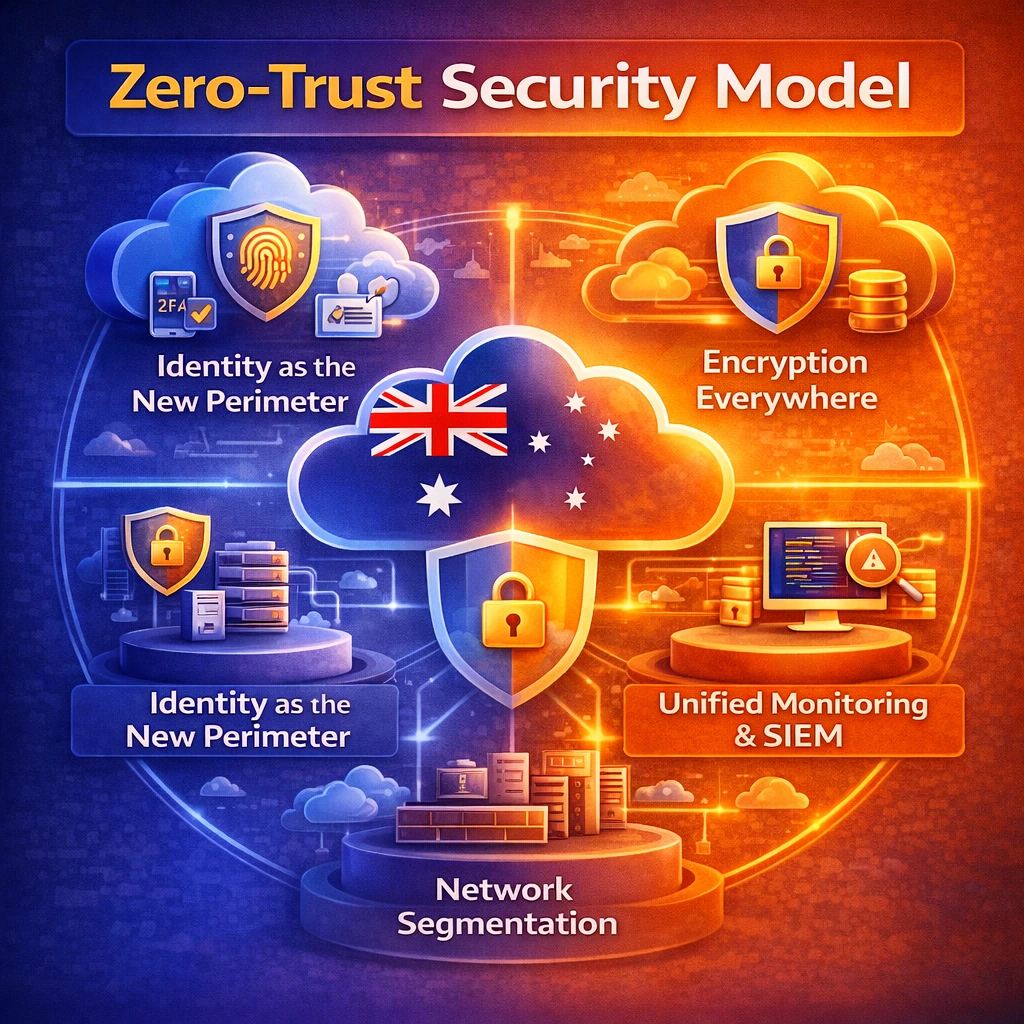
The single most important security principle for hybrid cloud environments is zero trust: never trust, always verify. In a hybrid architecture, traditional perimeter-based security (firewall at the edge of the data centre) is insufficient because workloads exist both inside and outside that perimeter simultaneously. Zero trust assumes that no user, device, or workload is inherently trusted — regardless of where it sits in the network. Every access request must be authenticated, authorised, and continuously validated.
Identity as the New Security Perimeter
In hybrid cloud environments, identity becomes the primary security control. With workloads and users spread across on-premises and cloud environments, the network perimeter no longer defines the security boundary — identity does. This means robust Multi-Factor Authentication (MFA), Privileged Identity Management (PIM), and conditional access policies are non-negotiable. Microsoft Entra ID provides these capabilities across both on-premises Active Directory and Azure services.
Encryption Everywhere
All data in transit between on-premises and public cloud environments must be encrypted — this applies to VPN tunnels, dedicated connections, and API traffic. Data at rest must also be encrypted in both environments using consistent key management practices. In a hybrid environment, encryption key management becomes particularly complex and requires a centralised approach.
Unified Monitoring and SIEM
Security visibility is the hardest challenge in hybrid architectures. Logs, alerts, and events are generated in two distinct environments with different tooling, different log formats, and different detection capabilities. A Security Information and Event Management (SIEM) platform that aggregates data from both environments is essential for detecting threats that span across private and public infrastructure. Our managed cybersecurity services include unified monitoring across hybrid environments, giving businesses continuous visibility without building and staffing a dedicated SOC.
Consistent Patch Management
One of the most common security failures in hybrid environments is inconsistent patching — cloud instances are updated automatically while on-premises servers fall behind. The ASD’s Essential Eight framework mandates timely patching as a top-priority control. In hybrid architectures, patch management must be governed centrally to ensure both environments maintain the same patching cadence and vulnerability exposure.
Network Segmentation
Flat networks are catastrophic in hybrid environments. If an attacker compromises a workload in one environment, network segmentation limits how far they can move laterally. Micro-segmentation — enforced through cloud security groups, on-premises firewall rules, and software-defined networking — should be applied consistently across both private and public infrastructure.
Hybrid Cloud Architecture Challenges (And How to Address Them)
Hybrid cloud is powerful, but it comes with real challenges. Understanding them upfront lets you design your architecture to avoid the most common pitfalls.
Challenge 1: Complexity of Management
The problem: Managing two environments with different toolsets, different operational models, and different teams creates fragmentation, inconsistency, and operational overhead.
The solution: Invest in a unified management platform (Azure Arc, AWS Systems Manager, or VMware Cloud Foundation) and enforce Infrastructure-as-Code practices so deployments are consistent and repeatable across both environments.
Challenge 2: Network Latency Between Environments
The problem: Applications that rely on frequent data exchange between on-premises and cloud environments can suffer from latency if connectivity is not properly designed.
The solution: Use dedicated connections (Azure ExpressRoute or AWS Direct Connect) for latency-sensitive workloads. Design applications to minimise cross-environment data calls — keep tightly coupled components in the same environment.
Challenge 3: Data Governance and Compliance
The problem: In a hybrid environment, data can inadvertently flow to regions or environments that violate data sovereignty requirements — a significant risk for Australian businesses operating under the Privacy Act 1988 and the Notifiable Data Breaches scheme.
The solution: Define explicit data classification policies before designing your architecture. Tag all data at ingestion with classification labels that drive automated governance rules — ensuring sensitive data stays on-premises or within Australian cloud regions.
Challenge 4: Cost Visibility and Control
The problem: Hybrid environments make cost attribution complex. Cloud spend is variable and metered; on-premises is fixed capital. Without unified cost management, teams lose visibility and cloud bills grow unchecked.
The solution: Implement tagging standards across all cloud resources from day one. Use cloud cost management tools (Azure Cost Management, AWS Cost Explorer) alongside traditional IT asset management for a unified view of infrastructure spend. Our proactive IT management approach includes regular cost optimisation reviews as part of ongoing managed services.
Challenge 5: Skills and Expertise Gaps
The problem: Hybrid cloud architecture requires expertise across multiple domains — networking, cloud platforms, security, DevOps, and compliance. Most SMB IT teams have gaps in at least some of these areas.
The solution: Partner with a managed IT provider with hybrid cloud expertise rather than trying to build all capabilities in-house. See our IT consulting services for how we support businesses in designing, deploying, and operating hybrid cloud environments.
Is Hybrid Cloud Architecture Right for Your Business?
Hybrid cloud is not the right answer for every business. For some organisations — particularly those with simple, greenfield IT environments or no legacy infrastructure — a cloud-first or even cloud-only approach may deliver better outcomes with less complexity. Use this framework to assess whether hybrid cloud is right for you.
Consideration | Hybrid Cloud Makes Sense | Cloud-Only May Be Better |
Do you have existing on-premises infrastructure with remaining useful life? | Yes | No |
Do you operate under data sovereignty or industry compliance requirements? | Yes | No |
Do you have workloads with highly variable demand? | Yes | No |
Are some of your applications mission-critical and require direct hardware control? | Yes | No |
Are you an early-stage business with no legacy IT? | No | Yes |
Do you have the internal skills or MSP partner to manage hybrid complexity? | Yes | No |
Is your current infrastructure nearing end-of-life with no value in extending it? | No | Yes |
Do you require low-latency data processing that public cloud cannot deliver? | Yes | No |
Hybrid Cloud Architecture in the Australian Business Context
For Australian businesses — particularly SMBs in Sydney and across NSW — hybrid cloud architecture addresses several challenges that are specific to the local market. The 2025 cyber threat landscape for Australian SMBs highlights that Australian organisations remain highly targeted, and that organisations with fragmented, legacy-heavy IT environments are disproportionately affected.
Data Sovereignty Requirements
Australia’s Privacy Act 1988 and the Notifiable Data Breaches scheme impose strict obligations on how personal data is stored and processed. For many businesses — particularly in healthcare, legal, financial services, and government — this means certain data simply cannot reside on foreign cloud servers. Hybrid cloud architecture provides the control to keep sensitive data on Australian infrastructure while leveraging global cloud platforms for non-sensitive workloads.
The Essential Eight and Hybrid Cloud
The ASD’s Essential Eight cybersecurity controls are increasingly relevant for businesses of all sizes, and the Essential Eight checklist for 2025 makes clear that controls like application patching, MFA, and application control must be applied consistently across all environments. Hybrid cloud architectures that implement centralised identity management, unified patching, and consistent access controls naturally align with Essential Eight compliance — but only if security is designed in from the start, not bolted on after.
Microsoft Azure as the Dominant Hybrid Platform in Australia
For most Australian businesses, Microsoft Azure is the natural public cloud platform for hybrid architectures — primarily because most already run Microsoft 365, Active Directory, and Windows Server on-premises. Azure Arc, Azure ExpressRoute, and the integration between Microsoft Entra ID and on-premises Active Directory make Azure the most seamless choice for building hybrid connectivity. Australia also has multiple Azure regions (Sydney and Melbourne) ensuring data sovereignty for Australian workloads. Explore how Microsoft 365 security features complement a hybrid cloud strategy.
Backup and Disaster Recovery in Australian Hybrid Environments
Natural disasters, power outages, and cyberattacks have reinforced the importance of disaster recovery for Australian businesses. Hybrid cloud architecture provides the foundation for cost-effective, geographically distributed DR — but only if backup strategies are designed explicitly for the hybrid model. Our guide on backup for Microsoft 365 and our disaster recovery plan checklist are essential reading for any business planning a hybrid cloud deployment.
How to Implement a Hybrid Cloud Architecture: A Practical Roadmap
Building a hybrid cloud environment is not a single project — it’s a staged programme of work. Here is a practical implementation roadmap for Australian SMBs.
- Phase 1: Assessment and Strategy (Weeks 1–4). Audit your existing application portfolio. Classify workloads by sensitivity, compliance requirements, performance needs, and change velocity. Define your target hybrid architecture and which workloads will live where. Identify skill gaps and partner requirements.
- Phase 2: Foundation and Connectivity (Weeks 4–8). Establish the network foundation — VPN or dedicated connectivity to your chosen cloud provider. Deploy unified identity management (Entra ID with AD Connect if using Azure). Establish baseline security controls: MFA, conditional access, network segmentation.
- Phase 3: Initial Workload Migration (Weeks 8–16). Start with low-risk, high-value candidates — development environments, test systems, backup targets, or workloads that clearly benefit from cloud elasticity. Validate connectivity, performance, and security before proceeding. Our cloud migration services team manages this phase end-to-end.
- Phase 4: Operational Integration (Weeks 12–20). Deploy unified monitoring, logging, and alerting across both environments. Establish Infrastructure-as-Code templates for consistent deployments. Integrate cloud cost management and governance tooling. Train your team on hybrid operations.
- Phase 5: Continuous Optimisation (Ongoing). Review workload placement regularly. Right-size cloud resources. Identify candidates for further modernisation. Conduct periodic security reviews and compliance audits. Update your DR plans as the environment evolves.
Ready to Design Your Hybrid Cloud Architecture?
Hybrid cloud architecture is not a product you can simply purchase — it’s a discipline that requires careful design, expert implementation, and ongoing management. The businesses that get it right gain a genuine competitive advantage: the agility of the cloud combined with the control and performance of private infrastructure.
At CodeHyper, we help Australian businesses design, deploy, and manage hybrid cloud environments that are secure, compliant, and optimised for their specific workloads. Whether you’re taking your first steps toward cloud adoption or looking to optimise an existing hybrid environment, our team brings the architecture, security, and operational expertise to deliver outcomes that last.
Explore our cloud migration services for a full picture of how we approach cloud strategy, or contact us today to book a free hybrid cloud assessment for your business.
Frequently Asked Questions: Hybrid Cloud Architecture
What is hybrid cloud architecture in simple terms?
Hybrid cloud architecture is a computing environment that combines your own private infrastructure — either on-premises servers or a private cloud — with one or more public cloud services, allowing workloads and data to move between them under a unified management and security framework. It gives businesses the control of private infrastructure alongside the scalability and flexibility of the public cloud.
What are the main components of a hybrid cloud architecture?
The core components are: private cloud or on-premises infrastructure, public cloud services (such as Azure or AWS), a hybrid connectivity layer (VPN or dedicated links), unified identity and access management, centralised security and compliance controls, orchestration and management tools, and data management and portability capabilities.
What is the difference between hybrid cloud and multi-cloud?
Hybrid cloud integrates private or on-premises infrastructure with public cloud services. Multi-cloud refers to using multiple public cloud providers simultaneously. Many organisations use both — a hybrid multi-cloud approach that combines on-premises systems with two or more public cloud platforms.
What are the biggest security risks in a hybrid cloud environment?
The main security risks include expanded attack surfaces at every connectivity point between environments, inconsistent security policies across private and public infrastructure, misconfigured cloud resources, gaps in patch management, and identity and access management weaknesses. A zero-trust security model and a professional cloud security assessment are essential starting points for addressing these risks.
Is hybrid cloud more expensive than full public cloud?
It depends on your workloads and how well the architecture is designed. Hybrid cloud has higher upfront capital costs (private infrastructure) but can deliver lower total cost of ownership if your on-premises assets still have value. For businesses with existing infrastructure, hybrid cloud avoids the cost of migrating everything to the cloud immediately while still enabling cloud benefits for the workloads that need them most.
What is cloud bursting in hybrid cloud architecture?
Cloud bursting is a hybrid cloud design pattern where workloads run on private infrastructure under normal conditions but automatically overflow to the public cloud when demand spikes. It allows businesses to handle peak loads without provisioning on-premises capacity for scenarios that may only occur occasionally.
How does hybrid cloud support disaster recovery?
Hybrid cloud enables cost-effective disaster recovery by using the public cloud as a DR target. Critical workloads are replicated continuously from on-premises to cloud environments, and in the event of an on-premises failure, cloud-based replicas can be activated within minutes. This is far cheaper than building and maintaining a traditional secondary data centre. See our disaster recovery plan checklist for a practical guide to getting started.
What is the role of Microsoft Azure in hybrid cloud for Australian businesses?
Azure is the most widely adopted hybrid cloud platform for Australian businesses, primarily because of its deep integration with on-premises Microsoft technologies (Active Directory, Windows Server, Microsoft 365). Azure Arc provides unified management across on-premises and cloud, while Azure ExpressRoute delivers dedicated connectivity to Azure’s Australian data centres. Microsoft Entra ID bridges on-premises and cloud identity seamlessly — making Azure the natural choice for businesses already invested in the Microsoft ecosystem.
How does the Essential Eight relate to hybrid cloud architecture?
The ASD’s Essential Eight controls — including application patching, MFA, application control, and restricting admin privileges — must be applied consistently across all environments in a hybrid architecture. Hybrid cloud environments managed with centralised identity, automated patching, and unified monitoring make Essential Eight compliance significantly easier to achieve and maintain. Our Essential Eight guide explains each control in detail.
How do I get started with hybrid cloud architecture for my Australian business?
The best starting point is an application portfolio assessment — understanding what you have, where it should live, and how environments need to connect. From there, a phased implementation approach minimises disruption while progressively delivering hybrid cloud benefits. Contact the CodeHyper team for a free consultation and hybrid cloud readiness assessment tailored to your business.