Most businesses don’t realise how inefficient their IT environment has become until something breaks.
Slow systems. Random outages. Rising cloud bills. Security gaps. Constant “small” issues that never quite go away.
This is exactly what IT infrastructure optimisation is designed to fix.
In this guide, you’ll learn what infrastructure optimisation really means, where most companies waste money and performance, and how modern organisations systematically improve reliability, security, and scalability.
What Is IT Infrastructure Optimisation?
IT infrastructure optimisation is the process of:
- Improving performance
- Reducing unnecessary cost
- Increasing reliability and uptime
- Strengthening security
- Simplifying management
- Aligning IT with actual business needs
It covers your:
- Servers (on-prem or cloud)
- Network
- End-user devices
- Microsoft 365 / cloud services
- Storage and backups
- Security layers
It’s not about buying new tools. It’s about making what you already have work properly.
Why Most IT Environments Slowly Become Inefficient
IT environments don’t usually become bad overnight. They degrade slowly because:
- Old systems are never fully retired
- Temporary fixes become permanent
- Cloud services are added without governance
- Security is bolted on instead of designed
- Nobody owns long-term architecture decisions
The result:
- More complexity
- More cost
- More risk
- Worse performance
The Real Business Impact of Poor Infrastructure
Unoptimised infrastructure leads to:
- Slower staff productivity
- More downtime
- Higher support costs
- Higher cloud and licensing spend
- More security exposure
- Harder scaling
According to IBM’s research on outages and incidents, downtime and IT incidents cost businesses enormous amounts in lost productivity and recovery, and most are caused by preventable configuration and design issues.
Optimised vs Unoptimised IT Infrastructure
Here’s the difference in the real world:
Area | Unoptimised Infrastructure | Optimised Infrastructure |
Performance | Slow, inconsistent | Fast, predictable |
Reliability | Frequent issues | Stable, resilient |
Costs | Rising and hard to explain | Controlled and predictable |
Security | Gaps and blind spots | Layered and monitored |
Scalability | Painful and risky | Planned and smooth |
Management | Reactive firefighting | Proactive improvement |
This gap is exactly why many businesses move to managed IT services instead of break-fix support.
The 6 Core Areas of IT Infrastructure Optimisation
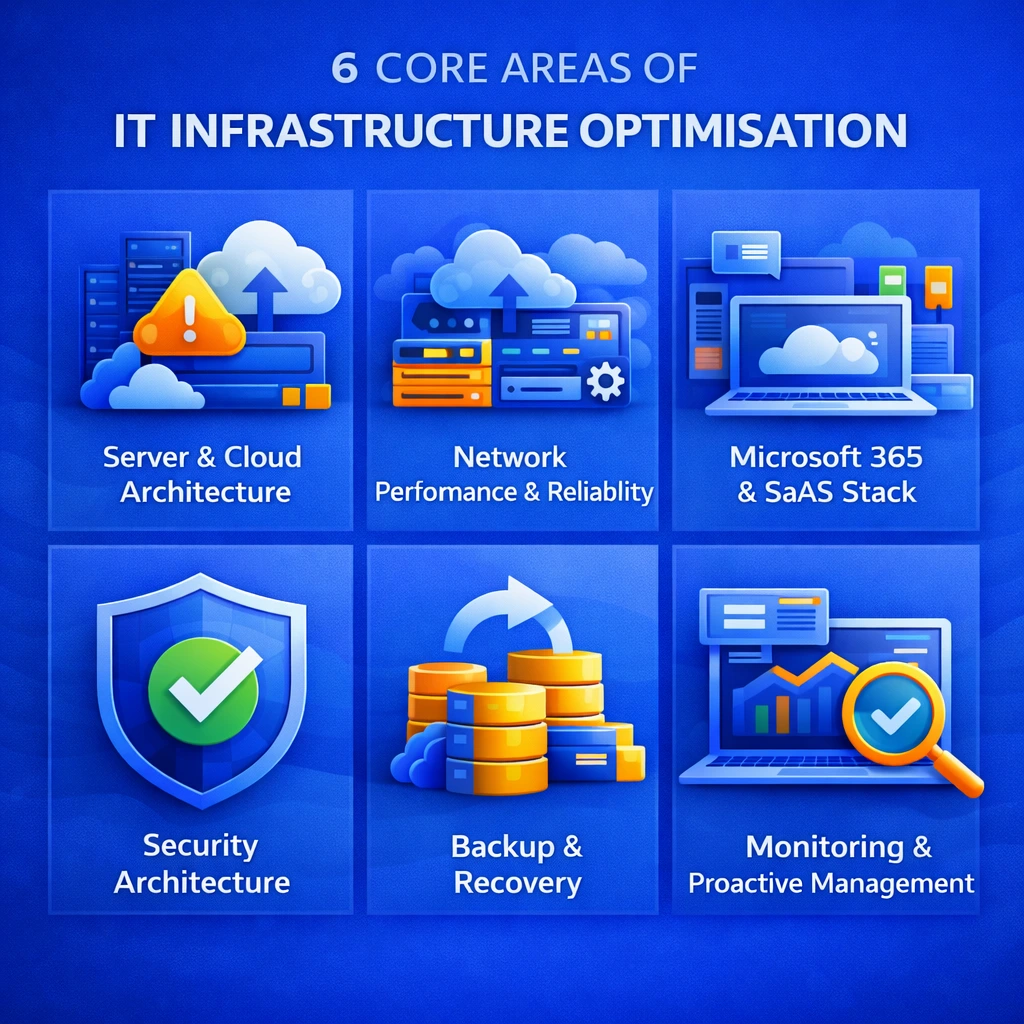
1) Server and Cloud Architecture
This includes:
- Right-sizing servers and cloud resources
- Removing unused systems
- Consolidating workloads
- Improving redundancy and failover
- Eliminating single points of failure
Cloud becomes especially expensive when it’s not actively optimised.
2) Network Performance and Reliability
Slow networks destroy productivity.
Optimisation focuses on:
- Removing bottlenecks
- Proper firewall and switch configuration
- Secure remote access
- Reliable Wi-Fi coverage
- Traffic prioritisation
3) Microsoft 365 and SaaS Stack
Most businesses underuse and misconfigure Microsoft 365.
Optimisation includes:
- Proper SharePoint and Teams architecture
- Identity and access controls
- Licence rationalisation
- Security configuration
- Data governance
This is why many companies use a Microsoft 365 managed services provider.
4) Security Architecture
Security should be:
- Built into the infrastructure
- Not bolted on later
Optimisation includes:
- MFA everywhere
- Conditional access
- Proper endpoint protection
- Centralised logging and monitoring
- Backup and disaster recovery
Microsoft confirms that MFA alone blocks the vast majority of account compromise attacks.
This is why infrastructure optimisation and cybersecurity services are tightly connected.
5) Backup, Resilience, and Recovery
Optimised environments:
- Have multiple backup layers
- Test restores regularly
- Can recover quickly from ransomware or failure
- Are designed for business continuity
If recovery is slow or uncertain, the infrastructure is not optimised.
6) Monitoring and Proactive Management
You cannot optimise what you cannot see.
Modern environments require:
- 24/7 monitoring
- Performance baselines
- Capacity planning
- Trend analysis
- Proactive maintenance
This is the difference between proactive IT and constant firefighting.
A Realistic Optimisation Process
In practice, optimisation usually follows this cycle:
- Full environment assessment
- Identify bottlenecks, waste, and risk
- Prioritise by business impact
- Implement improvements in phases
- Continuously review and refine
This is not a one-time project. It’s an ongoing discipline.
Important Reality Check
IT infrastructure optimisation does not mean:
- You’ll never have issues again
- You’ll never need upgrades
- Everything becomes “perfect”
It means:
- Problems are rarer
- Impact is smaller
- Costs are controlled
- Scaling is predictable
- Security is stronger
When Should a Business Optimise Its Infrastructure?
If any of these are true, you’re overdue:
- Systems feel slow
- Cloud bills keep rising
- Downtime happens too often
- Security worries you
- IT feels fragile or messy
- Growth feels risky
How CodeHyper Helps
CodeHyper helps Australian businesses:
- Assess their current environment
- Design cleaner, safer architectures
- Reduce waste and cost
- Improve reliability and performance
- Implement ongoing proactive management
This is delivered through their managed IT services, Microsoft 365 expertise, and cyber security capabilities working together.
FAQs
Is IT infrastructure optimisation only for large companies?
No. SMEs often benefit the most because inefficiency hurts them more.
Does optimisation mean moving everything to the cloud?
Not necessarily. It means using the right mix of cloud and on-prem for your needs.
How often should infrastructure be reviewed?
At least annually, with continuous monitoring in between.
Is this a one-time project?
No. IT environments constantly change. Optimisation is an ongoing process.