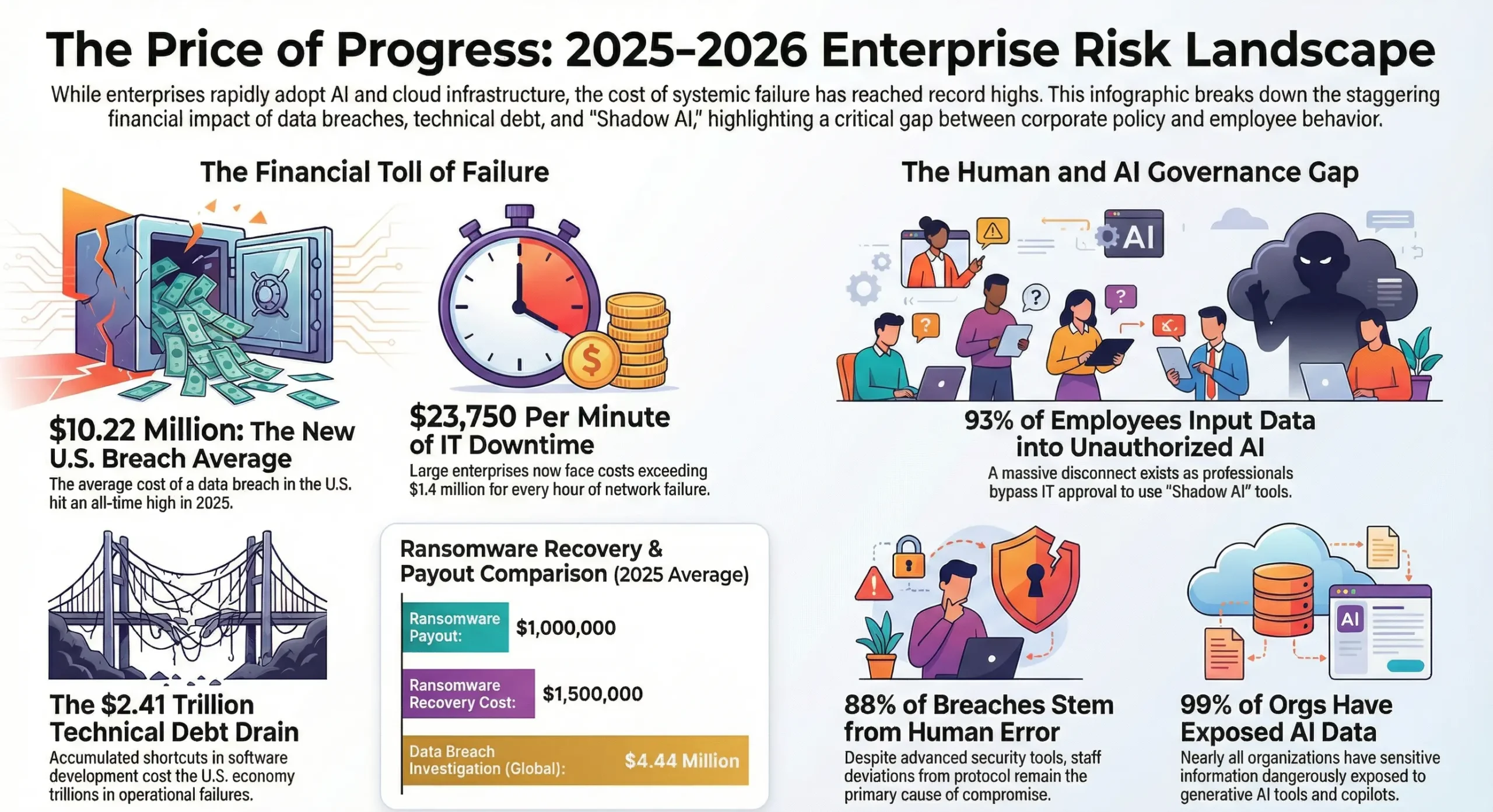
If IT is still being treated as a cost centre, that is not a budgeting decision.
It is a leadership decision.
And in 2026, it is a dangerous one.
Technology is no longer a support department operating in the background. It is the infrastructure that enables revenue, compliance, communication, customer engagement, payroll, cybersecurity, and growth.
When IT stops, the business stops.
There is no workaround.
Modern Organisations Operate Through Technology — Not Around It
Every critical function now relies on digital systems:
- Communication platforms
- Cloud infrastructure
- Payment systems
- Data storage
- CRM and marketing automation
- Cybersecurity frameworks
- AI-enabled tools
IT is not an overhead. It is operational architecture.
Treating it as an expense to minimise rather than an asset to optimise creates systemic fragility.
Downtime Is a Business Exposure, Not an IT Issue
A server failure is not a technical inconvenience.
An email outage is not minor disruption.
A website crash is not “bad luck.”
Each event affects:
- Revenue generation
- Customer trust
- Brand credibility
- Operational productivity
- Regulatory compliance
Downtime compounds quietly. The financial impact is rarely isolated to a single event. It spreads through lost opportunities, delayed decisions, and reputational damage.
Resilience is no longer optional. It is a leadership responsibility.
The Cost Argument No Longer Holds
The belief that enterprise-grade IT capability is unaffordable is outdated.
Cloud computing, managed services models, and predictable monthly cost structures have removed the traditional capital barrier.
Modern businesses can now access:
- Scalable infrastructure
- Proactive monitoring
- Cybersecurity frameworks
- Backup and disaster recovery
- AI governance structures
Underinvestment in IT today is not about affordability. It is a decision to accept preventable operational risk.
The real question is not, “What does IT cost?”
It is, “What does unmanaged risk cost?”
AI Is Already Inside Your Organisation — Without Governance
AI adoption is not a future consideration. It is already happening.
Employees are using public AI tools to:
- Draft reports
- Analyse data
- Summarise internal documents
- Assist with strategic planning
Without governance, sensitive organisational context is being fed into external systems.
This creates:
- Data exposure risk
- Compliance concerns
- Intellectual property leakage
- Strategic visibility to third parties
AI governance must now sit alongside cybersecurity and infrastructure strategy.
Ignoring this reality does not slow AI adoption. It removes leadership control.
Cybersecurity Failure Is Usually Human, Not Technical
Technology alone does not protect organisations.
Most breaches occur due to:
- Phishing emails
- Credential compromise
- Poor access controls
- Inadequate user training
- Overconfidence in systems
Hosting servers on-premises does not eliminate risk.
Moving to cloud does not eliminate risk.
Security depends on disciplined processes and educated users.
An organisation without continuous cybersecurity awareness training does not have a security strategy. It has vulnerability.
You May Not Know What Is Already Exposed
Routine digital behaviour reveals:
- Performance patterns
- Expansion signals
- Operational weaknesses
- Strategic direction
Competitive intelligence no longer requires hacking. Pattern observation is often enough.
By the time exposure becomes visible, damage has usually already occurred.
Proactive monitoring, structured governance, and leadership visibility are now business essentials.
AI Will Reshape Organisations — Leadership Determines the Outcome
AI will eliminate inefficiencies. That includes roles.
What remains optional is whether leadership directs AI adoption strategically or reacts to it defensively.
Leaders who:
- Implement governance frameworks
- Train teams responsibly
- Define usage boundaries
- Align AI tools with business strategy
retain control.
AI does not replace strong leadership.
It exposes weak governance.
Final Position
IT is not a cost centre.
It is not negotiable.
It is not optional.
It is operational infrastructure.
Organisations must strengthen their digital posture, cybersecurity maturity, and AI governance now — or accept unmanaged exposure across revenue, data, and reputation.
There is no neutral position.
Leadership chooses resilience.
Or leadership chooses risk.
FAQs
What does it mean when IT is treated as a cost centre?
Treating IT as a cost centre means viewing technology purely as an expense to minimise rather than a strategic asset that drives revenue, efficiency, resilience, and competitive advantage.
Why should IT be considered a strategic investment?
IT supports communication, compliance, customer engagement, cybersecurity, AI adoption, and operational continuity. Strategic investment reduces downtime risk and strengthens long-term business stability.
How does downtime impact business performance?
Downtime affects revenue generation, customer trust, employee productivity, compliance obligations, and brand credibility. Even short disruptions can create long-term financial and reputational damage.
Why is AI governance important for businesses?
AI tools are already being used within organisations. Without governance, businesses risk data exposure, compliance breaches, and loss of intellectual property. Structured AI governance ensures safe and strategic adoption.
Can managed IT services reduce business risk?
Yes. Proactive monitoring, cybersecurity frameworks, disaster recovery planning, and structured IT governance significantly reduce operational and security risks while improving cost predictability.