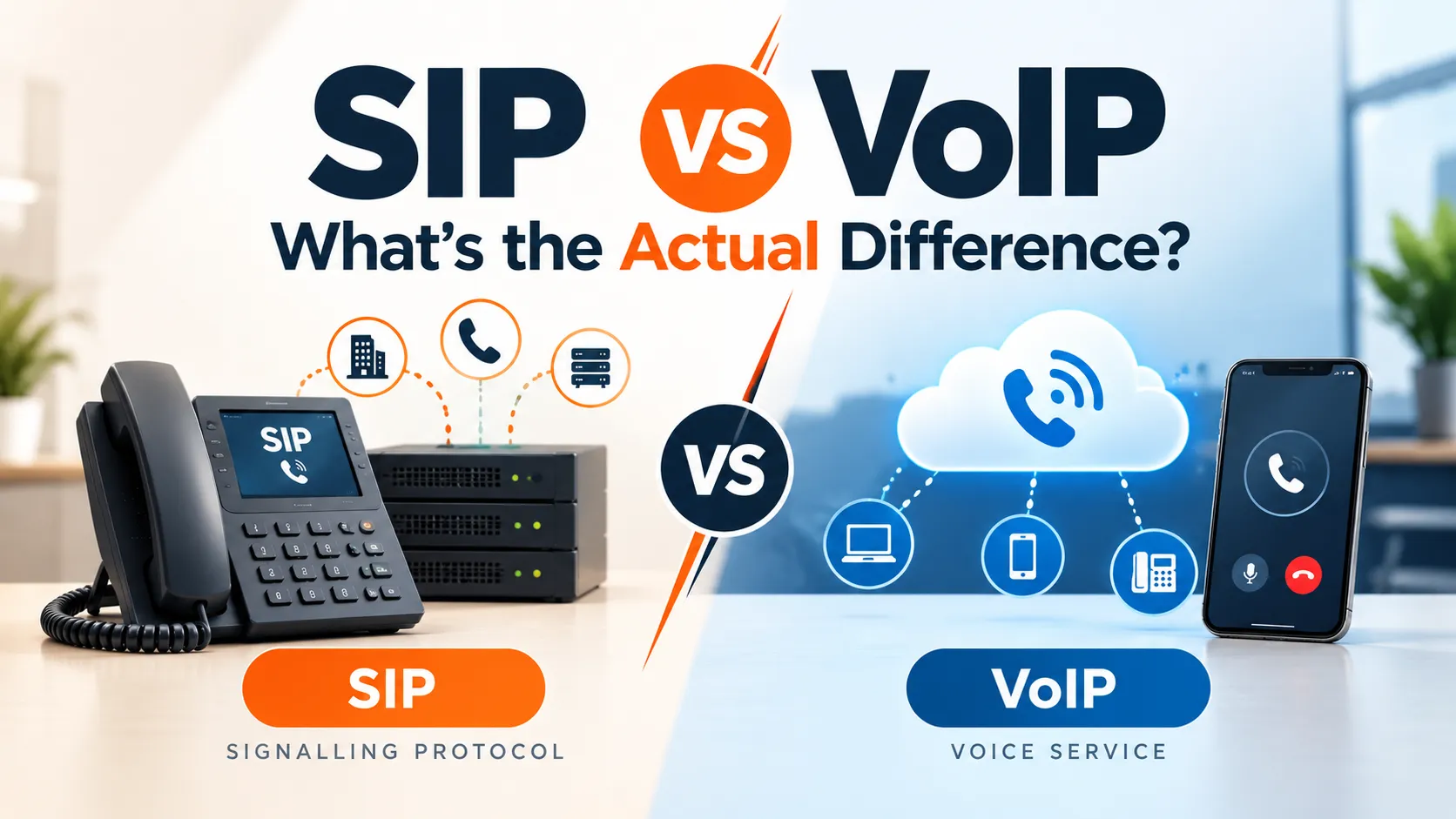
If you’ve been comparing business phone systems, you’ve probably seen SIP and VoIP used in the same sentence, sometimes even used to mean the same thing. They’re related, but they’re not interchangeable, and understanding the difference actually matters once you start comparing quotes, because providers don’t always explain which one they’re selling you.
What VoIP actually is
VoIP stands for Voice over Internet Protocol. It’s the broad term for any phone call carried over the internet instead of a traditional copper phone line. If a call is travelling as data over your internet connection rather than through the old public phone network, it’s VoIP. That’s the whole definition. It doesn’t tell you how the call gets set up or what technology is doing the work behind the scenes, just that it’s happening over the internet.
What SIP actually is
SIP stands for Session Initiation Protocol. It’s not a type of call, it’s the method used to set one up. When you make a VoIP call, something has to handle the process of finding the other device, agreeing on how the audio will be sent, ringing the phone, and then closing the connection cleanly once the call ends. SIP is the set of rules that handles exactly that, both for voice calls and for other things like video and instant messaging.
The difference in one sentence
VoIP describes what’s happening, a call over the internet. SIP describes how it’s actually being set up and managed behind the scenes.
A simpler way to picture it
Think of VoIP as the phone call itself, the conversation you’re actually having. SIP is more like the switchboard operator making sure the call gets connected to the right person, stays connected properly, and hangs up cleanly when you’re done. You don’t usually think about the operator during the call. That doesn’t mean nothing is happening behind the scenes to make it work.
Why the two terms get mixed up so often
Most business VoIP systems use SIP to actually run, so in everyday conversation people started using the two words as if they meant the same thing. It’s a bit like how people say Google when they mean search engine in general. Technically not quite accurate, but close enough that nobody usually corrects it. The mix up becomes a real issue only when you’re comparing providers, because a system built on SIP behaves differently to one built on a closed, proprietary system, even though both would fairly be described as VoIP.
Do you actually need to understand the difference to choose a system
Mostly, no, not in day to day use. What matters more is knowing which questions to ask a provider. If a system is SIP based, it tends to be more flexible, easier to move between providers, and more compatible with existing business phone hardware. If it’s built on a closed, proprietary protocol instead, switching providers later can mean replacing more of your setup than you’d expect.
A situation this actually comes up in
We had a client come to us wanting to move to VoIP, and assumed that meant picking whichever provider had the cheapest monthly plan. They already had a reasonably new PBX system installed the year before and were keen to keep using it rather than replace it again. It turned out the plan they were originally quoted was built on a closed system that wouldn’t work with their existing hardware at all, and switching to it would have meant scrapping equipment that still had years of life left in it. Once we found a SIP based provider instead, their existing PBX connected without any extra hardware, and the whole move cost a fraction of what the first quote would have. The lesson there wasn’t really about VoIP versus SIP as concepts, it was that asking one extra question before signing anything can save a business a genuinely large unnecessary cost.
A quick side by side
VoIP is the general category. SIP is one specific protocol within that category, though by far the most widely used one.
VoIP tells you a call is happening over the internet. SIP tells you the technical language being used to manage that call.
A closed VoIP platform can lock you into specific hardware and software. A SIP based system generally gives you more freedom to change providers or keep existing equipment.
Most modern business phone systems in Australia are SIP based, even when they’re simply marketed as VoIP.
Which one your business actually needs
You’re not really choosing between SIP and VoIP as separate products, since almost every serious business VoIP system runs on SIP underneath. What you’re actually choosing is whether a provider’s system is open and SIP based, giving you flexibility and hardware compatibility, or closed and proprietary, which can be simpler upfront but harder to move away from later. If you already own PBX hardware or expect to want more control down the track, ask specifically whether the system is SIP based before signing anything. For a more detailed look at how SIP trunking specifically connects to existing phone hardware, our guide on what a SIP trunk actually is covers that step in more depth. For readers who want the full technical specification behind SIP itself, the Internet Engineering Task Force’s SIP standard is the original source document, though it’s written for engineers rather than business owners.
Getting the right setup without the guesswork
The honest answer for most businesses is that the SIP versus VoIP distinction matters less than picking a provider who explains it properly upfront, rather than one who lets the confusion work in their favour. We help Sydney businesses work out which setup actually fits their existing equipment and future plans, rather than starting from whichever plan looks cheapest on paper. Our guide on VoIP technology is a good starting point if you’re comparing options, or get in touch with our team and we’ll ask the right questions before you sign anything. You can also see how we approach it on our VoIP phone services page.
FAQs
Is SIP the same thing as VoIP? No, though they’re closely related. VoIP describes any phone call made over the internet. SIP is the specific protocol most commonly used to set up, manage and end those calls, and most business VoIP systems use it, even when marketed simply as VoIP.
Can you have VoIP without SIP? Yes. Some VoIP platforms use their own closed, proprietary system instead of SIP to manage calls. It works, but it can limit flexibility, particularly when it comes to keeping existing phone hardware or switching providers later.
Why do people use SIP and VoIP interchangeably? Because the vast majority of business VoIP systems are built on SIP, the two terms have blended together in everyday conversation, even though technically one describes the call and the other describes how it’s set up.
Does it matter which one my provider uses? It can, particularly if you already own PBX hardware or expect to want the flexibility to change providers later. A SIP based system generally offers more compatibility and freedom than a closed, proprietary one.
Is SIP trunking the same as SIP? Not quite. SIP is the underlying protocol. SIP trunking is a specific service that uses that protocol to connect a business phone system to the internet in place of a traditional physical line.
How do I know if a VoIP provider is SIP based? Ask directly before signing up. A provider offering a genuinely SIP based service should be able to confirm it clearly and explain how it works with your existing phone hardware, rather than avoiding the question.